
 Los Angeles Trade Technical College, the career-based community college located on Grand Ave and Washington Bl downtown, completed the first round of an aggressive building campaign early last week. For a long time, the 21-acre campus hardly resembled a college campus at all, and bore more similarities to the gritty industrial tracts that surround it. But administrators are hoping to turn around that rough-hewn image with a sprinkling of new buildings that the architect calls "competitive" with other downtown buildings. This first $85m phase is a small slice of the $600m that voters approved for campus renovations and additions back in 2002.
The two five-story buildings are located on Grand Ave between Washington and 23rd St., and were designed by MDA Johnson Favarro. Both buildings are about 120,000 sf and are expected to receive LEED Silver certification. When the Spring semester begins in February, the buildings will be home to 2 lecture halls; the admissions, registration, and administration offices; and various other offices and classrooms. Plans also call for a rooftop photovoltaic system that will supply up to 20% of the school's electricity demands. Up next for the school are a new track and field, a sports and wellness center, and a construction technology building.
The architecture, which features a suggestive combination of brick and concrete curving in Gehry-esque waves, is meant to represent "trade as art." On the rear are huge letters near the top of the building that spell out LATTC and are visible from the 10 and 110 freeways. The striking contrast of red brick and sinuous white walls forms a pleasing respite from the low, bland architecture that has come to define this stretch of Grand. But the buildings don't feel out of place here, as they seem to pay homage to the area's--and the school's--industrial heritage. The construction is not without fault however. The buildings frame what is dubbed an entry plaza and is meant to establish a new gateway for the campus, but instead forms just a typical driveway complete with security arms, and is hardly welcoming to pedestrians.
Source: LA Downtown News
Saturday, February 6, 2010
LA Trade Tech unveils phase I of massive building spree
Thursday, January 28, 2010
This Just In: Broad eyes Downtown for museum
3:07 PM | Beverly Hills, Culver City, Downtown, Eli Broad, Frank Gehry, Grand Ave, MOCA, museum, Santa Monica
 All of Downtown has been abuzz this week after billionaire developer/philanthropist Eli Broad officially announced that a Grand Ave site is also under consideration for his $60 million art museum and foundation headquarters. Just last week, we reported that a strange site in Culver City was Broad's elusive third choice. But the President of neighboring West LA College has heard nothing from Broad's people, so that revelation may have been a distraction.
Wednesday, December 9, 2009
Grand Ave Scales Back Amid Recession
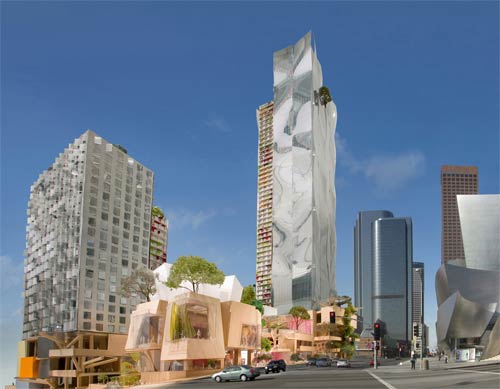
As for the 2.5 million sf condo-hotel-retail aspect? Related is still waiting on a $700m construction loan that, considering the sickness of the condo market, will be a long time coming. Also of concern is the state of Istithmar, the royal Dubai investment fund that has put $100m into the project, and was recently found to be drowning in $26b of debt. But as Witte has tenuously assured, the Dubai money has been "pretty much spent." Meanwhile, the pressure is on to see if Related can make good on its promise to deliver at least a portion of the project before its entitlements expire in 2011.
Saturday, June 27, 2009
Is Downtown Development Dead?
12:14 PM | adaptive reuse, AEG, Downtown, Eli Broad, Frank Gehry, Grand Ave, Jane Jacobs, LA Live, mixed-use, Ralph's
 The vacated construction site is an increasingly common sight in Downtown these days. Los Angeles Magazine recently published a dismal perspective on upcoming downtown growth - "lower your expectations," they say, "construction cranes will be a rare sight for at least several years." When the last touches on the $2.5 billion mega-project LA Live are complete at the beginning of next year, there will be little to get excited about in the area's development scene. The energy behind Downtown's initial renaissance was fueled mainly by two events: the adaptive reuse ordinance of 1999 which allowed underutilized office buildings to be converted to housing, and California's real estate boom which gave area median condo prices their dizzying peak of $790,000. But those prices have fallen a staggering 37% and 17,818 units are sitting unbuilt in development limbo.
The problem with the explosion in adaptive reuse is that there is a limited stock of historic buildings ready for conversion. Enter ground-up development, a trend made apparent by the countless new gleaming residential high-rises gracing the city's skyline, many of which are having trouble leasing up or even finishing construction. LA Live was supposed to be downtown's saving grace - it was a shiny mixed-use behemoth that entered the construction market at a shaky time, but was backed by reliable and committed investors. But those familiar with Jane Jacobs will remember that city redevelopment cannot be spurred by catastrophic events; in fact, these types of additions often cause rifts and boundaries in urban neighborhoods. While the entertainment complex has been hugely successful in attracting valuable credit tenants to an area they have long spurned, LA Live is remarkably inward-facing. The idea was that visitors arriving for concerts, conventions, games and the like would begin to leak through the streets of Downtown, spending money and "knitting" the region together as a whole. But obstacles like traffic and pedestrian-unfriendly streets have made this aspiration unlikely.
New area residents who have helped Downtown to double its population to 38,000 in ten years, might argue that their neighborhoods are already great, or are experiencing redevelopment independent of AEG, the entertainment developer behind LA Live. Great strides have been made in Downtown's comeback, but the reality is that countless units remain unlet. R etailers who were once flocking to open up downtown to fill the increased residential demand, are holding back, or are pulling out altogether. Rite-Aid's closure of its store at 7th and Los Angeles Streets caused massive speculation and debate among locals and in the blogosphere. Ralph's, whose new store at 9th and Flower Streets is one of the chain's highest-grossing, is often cited as one of Downtown's greatest accomplishments, and a sign that more large retailers are coming soon. Unfortunately, national retailers often wait as long as a decade to ensure a market is worth investing in. 'Who needs 'em?' say many residents, who value the impressive collection of small independent retailers who have opened up shop locally in recent years. But the truth is that the presence of the big guys (like the much-wanted Trader Joe's and Barnes and Noble) can contribute incalculably to the validation of a neighborhood.
Many players wonder what happened to the Grand Avenue project that was supposed to be the high-end, culture-rich master plan that anchored the north end of Downtown. Well it too is sitting in limbo for lack of construction loans. Apparently a Gehry-designed superstructure backed by Eli Broad isn't quite what it takes to get something built around here. After LA Live is complete and we start to get a sense of its successes and impacts, eyes will most likely start to turn back to Grand Ave as the next big catalyst for area growth. But that is assuming LA Live is successful enough to hold developers' attention on Downtown. And let's hope the construction climate will turn around at least partially by that time. Until then, we must rely on smaller projects more invested in the area's long term economy to help connect the dots in a confused and fluctuating downtown. Stay tuned.
Monday, April 13, 2009
Eli Broad Taunts LAUSD with Cash for Arts School
 Eli Broad recently pledged close to half a million dollars to support the enrollment of minority students at Juilliard, the elite New York City arts academy. This has left LAUSD back home in Los Angeles wondering - where's our money? The billionaire developer-philanthropist has proven his dedication to the city of Los Angeles and to the arts with tens of millions of dollars in donations over the years. He has mentioned an interest in supporting the arts at LA schools before, but this time it is critical. The school district plans to open Central Los Angeles High School #9 - a new flagship arts school - in the fall, but as of yet have no director for the school and little clue as to how to run it.
The school, which is in its last phase of construction, set the district back about $250 million. But because the school was built on the desirable district-owned Grand Avenue lot , an additional $190 million was spent to relocate the district's offices. The school has received much acclaim during construction, both for its proximity to the burgeoning arts corridor on Grand Ave downtown, and for its curious design by Austrian firm Coop Himmelblau. But as the 2009/10 school year approaches, district officials worry about the school's ability to open and operate smoothly.
Joining others, Broad has suggested the school be managed by an outside organization but continue to receive funding from the district. This charter school arrangement has been extremely successful in rehabbing other struggling local schools. But the district refuses. Another option is to delay the opening of the school for one more year, until everyone can truly agree on its mode of operation. But that delay would be costly and inefficient. Construction is nearing completion and the idea of maintaining a vacant school is both embarrassing and depressing. Whatever happens, it has to happen quick - Eli Broad won't be dangling his millions forever. If we don't suit his fancy here, he may just pack up and move back to Detroit. Or worse: New York.


 Posts
Posts


